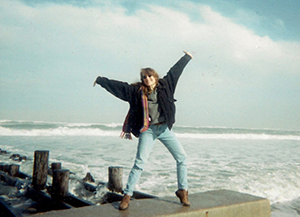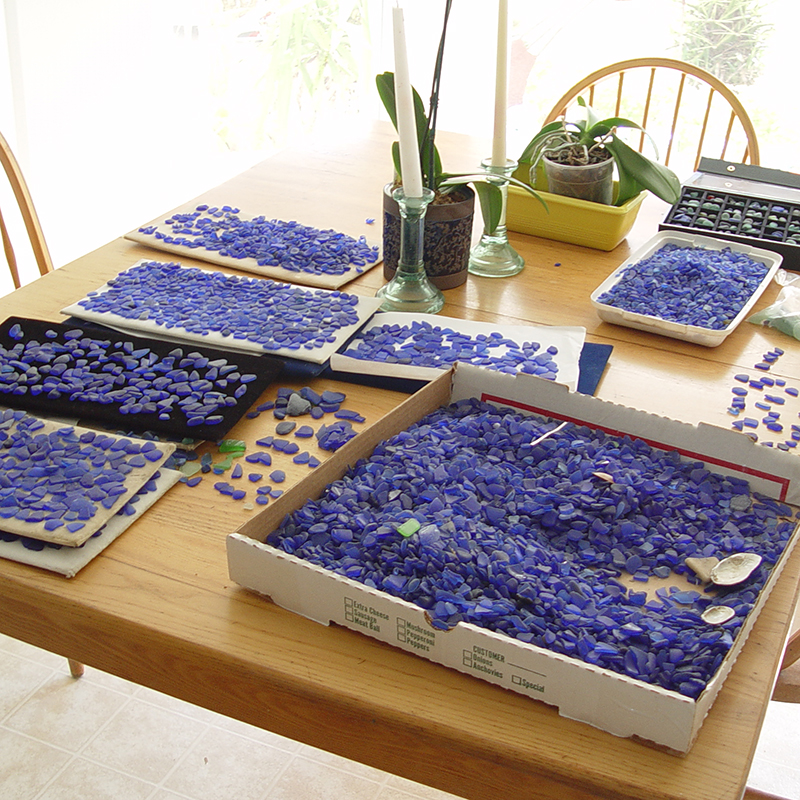
We began collecting sea glass on the OBX (Outer Banks of North Carolina.... and amassed a sizable personal collection of sea glass during our 20+ year residency, personally collecting all of our sea glass in the first 10 years of making sea glass jewelry.
In the mid 90's we had 2 hurricanes hit the OBX back to back, not producing significant real estate damage or news attention but erasing our pebble beds for more than 2 years. This was the time our business started to blossom and at this time we started to purchase and trade sea glass from reputable collectors and friends around the world.
We have now have amassed a collection of jewelry quality sea glass in the 1000 pound range and have invested over 100K in providing the best sea glass in the world.
While this sounds like a lot of sea glass, it can takes 100's of pieces to find matching pairs, Remember, we leave our glass just the way it was found on the beach. In acquiring so much glass over the years, we are able to offer such rare earring matches such are reds, oranges and multi colored glass on our site.
We will still purchase or trade sea glass, if you are interested, drop us an email.
A leader in the sea glass industry since the early 90's, By The Sea Jewelry is always striving to bring you new sea glass sources.
Purchasing Sea Glass Our first large collection of glass not personally found was based out of Aguadilla, Puerto Rico. Sizable sea gems in a myriad of colors arrived to me by mail from a friend who's husband was a helicopter pilot for the border patrol.... we soon found others when her hubby was reassigned in San Diego.
Most of our best glass in these years came from Puerto Rico. One of my original signature designs (Our Original Wire Bezel Setting©) started with this glass as it was thick and not suited to set in a wire wrapped setting.
About this time, the selling of loose sea glass on the internet had started and we started purchasing from around the globe - Prince Edwards Island, California, Hawaii and just recently in the last 7 years England.
Our Favorite Sea Glass
Seaham England - English Sea Glass is by far my favorite and now dominates my work. We have acquired a large collection of these rare incredible sea glass gems.
We were the FIRST company in the USA to discover this awesome sea glass source and have spent a great deal of time and money investing in our stock. We maintain the LARGEST collection of this fascinating sea glass in the country and it allows us to offer jewelry that is available no where else.
Seaham is a small coastal town in the North East of England not far from Sunderland and Newcastle in Durham County, famed for it's glass making history. Though glass making dates back to the Romans in this region , Victoran Era glass dating from the mid 1800's is a more likely source for this amazing Genuine Sea Glass.
"End Of Day Glass" - (the term) came about while conversing with our Brit friend about the origins of this glass....She simply called it sea glass, but I knew it was unique and wanted to find out why this area produced such unsual sea glass.
When I described it as "Slag" Glass (a term I was familiar with having family in the NE Coal mining regions and seeing many coal slag heap)........I was quickly told by my "friend" that "SLAG" was a derogatory name in the UK.....I then researched glass making and the term and I came up with in 2004 WAS "End Of Day Sea Glass".
End Of Day Sea Glass is NOW the common and standard term for Multi Sea Glass from Seaham England.
Traditionally though, "End Of Day" glass in antique glass collecting is where glass frits (small bits of ground colored glass) are incorporated into and final end piece...producing a multi colored effect. English End Of Day sea glass is seldom like true "End Of Day Glass" in collecting.
Every piece of English Sea Glass we sell comes with a FULL in depth description of this unique area, history and source.
Types Of English Sea Glass (Seaham Sea Glass)

Boulders and Bubbles Usually single color pieces that started as huge lumps of slag glass. These were chipped out of vats and discarded whole to the sea.
The characteristics are that they are very round and usually very large (depending on how long they have been rolling around).
We use bubbles in our minimal bezel setting and our NEW Deluxe Wire Bezel setting where a silver band is fashioned to the size of the glass then painstakingly burnished to enclose the glass. Bubbles are too round for most jewelry applications and tend to fracture when drilled. We also sell boulders in our Specimen Sea Glass Section.
Slag glass (above right) can still be purchased today from modern glass companies and is often used in aquariums for display.
Multi's - There are various theories on how Multi's came to be. One INCORRECT version is that that molten glass was mixed at the End Of The Day and either worked by glass workers as practice or simply combined in one vat as waste.
Since first acquiring this glass and posting the term End Of Day (or EndoDay) sea glass, we have researched glass making heavily.
Glass would be "gathered" up on a pipe (if being blown) or on a punty if being placed in a mold.
Excess glass from the "gather" was cut off and collected near the kiln. Colors would become mixed and layered then tossed out into the North Sea.
The best Multi's are those with 3 or more colors, and our favorites are cross sectioned pieces (shown left Above) where the colors are cross sectioned inside the glass instead of layered one on top of another.
Fisheyes (as they are called in Seaham) or Pontil pieces (as I refer to them) is usually clear glass used to tip a punty or pontil rod (the metal rod used to gather glass in the kiln).
Clear glass was the cheapest and therefore predominates the fisheyes found in this area, however, occasionally brightly colored fisheyes bases are found.
We have several in our personal collection where the bases are hues of aqua and blue, light blues and greens.
In a fisheye piece, you can see how the glass was pulled before being snapped off for final finishing. The Center of the glass remained hot and therfor stretched more as the outside cooled and was more stable.
Most fisheye or pontil pieces from Seaham have this characteristic thoug many are just a hint of color on a tip of white.
It is many years of glass knowledge that led me to this discovery and though this is originally MY theory,,,,they may have originated in a different way.
Another possibility is the result of a "stringer". Stringers are used in decorative glass making to apply intricate glass designs. Just like a punty, stringer bases are cheap glasses fused to more colorful and expensive glass. The tips of the stringers would be melted and applied to the object at hand.
I firmly though believe that due the thickness of most Fisheyes or Pontil pieces, that they were indeed punty tips. Unfortunately, the affirmation of this knowledge has passed with the generation of glass makers that produced these discards.

Flash Glass - So popular in Victorian English windows Flash Glass is where one color of glass is layered on top of another, then carved to reveal a contrasting pattern.
Flash glass was also used in decorative house wares (right - Victorian Glass Vase) such as vases and bowls.
Flash sea glass in distinctly 2 colors (rarely 3) and an even usually flat surface. We also collect Flash Sea Glass from Southern England.

Other Pieces - Other fascinating specimens can be found there, items called Whimsies or Friggers in glass making were usually items made by workers at the end of the day to practice their trade.
Items such as glass canes and pipes (impractical but pretty), pitchy dobbers (flat pressed glass used in hop scotch) and glass dumps (paper weights with designs blown inside - our personal find of a sea glass flower dump right) as they were made with glass that would have been "dumped" into the sea. Pieces of failed attempts of these items can sometimes be found on the beaches in this area.
Marbles - also abound on this beach and originate mainly from Codd bottles. These bottles had an internal marble that was pushed to the top of the bottle by the carbonation, thus sealing the opening. These were also made locally,
Villa Pop, a Sunderland company who started making soda in the late 1800's, made codd bottles from 1900 to 1912, which gives those marbles a direct date
The wares that were made in this factories in and around Seaham varied throughout time.
As a decorative or art glass factory which yielded incredible colors of glass in pinks, baby blues in the Deco Period to specimens of Victorian decorative artifacts can be seen at The National Glass Centre in Sunderland.
In later years, less glamorous objects such as New Castle Ale bottles (a vivid green unlike common green found in the states), Television Tubes, producing a thick gray blue sea glass, and more common colors such as olives and ambers that have distinct color unlike any found anywhere else in the world.
Though the bottle factory also produced the common colors of sea glass, the quality is far better than any we have every seen because of the conditions of the North Sea.
THIS CONTENT IS PROPERTY OF BY THE SEA JEWELRY - SANDYFEAT ENT INC. AND MAY NOT BE USED IN WHOLE OR IN PART UNLESS PERSMISSION IS FIRST OBTAINED. This means YOU Lisl, do you own work!
If you want to learn more about sea glass or find locations to collect sea glass near your or near you next vacation, come and join us at Sea Glass Lovers, the Largest and most Active Private Internet community dedicated to sea glass lovers around the world.
Over 5300 Members share over photos, craft and display ideas, beach locations, shard Id, 100's of member forums and over 40 specialized groups and much more! Visit us and sign up at Seaglasslovers SGL and sign up for a membership today!

SGL members share Beach Locations, Thousands of Photos, Display and Craft Ideas, Shard Id, Online Chat and MUCH MORE! This is a private Member ONLY community that is free to join! We are agenda FREE with no affiliation to any associations or political pandering. If you LOVE sea glass, you'll be glad you did!
Sea Glass Lovers - Join Today!
Visit SeaGlassLovers